Tag / Center for Practical Bioethics
-

![]()
December 2025 Bioethics Bulletin E-Newsletter
We focus on the bioethics of ECMO in the Center for Practical Bioethics’ December 18, 2025 Bioethics Bulletin. We discuss ECMO in our Ethics Dispatch and video case study, while professors Dr. Kayhan Parsi and Nanette Elster begin shaping programming that bridges scholarship and the practice of bioethics.
-
![]()
November 20 2025 Bioethics Bulletin E-Newsletter
Clinical ethics is the focus of the Center for Practical Bioethics’ November 20, 2025 Bioethics Bulletin. We discuss the bioethics principle of beneficence and using hospitals to continue to care for some patients instead of other recovery facilities which refuse to admit the patients.
-
![Kayhan Parsi, JD, PhD, HEC-C, and Nanette Elster, JD, MPH, as our John B. Francis Co-Chairs in Bioethics.]()
Interview with Kayhan Parsi and Nanette Elster: the John B. Francis Co-Chairs in Bioethics
Interview with Kayhan Parsi and Nanette Elster: the John B. Francis Co-Chairs in Bioethics Since joining the Center this fall, Professors Kayhan Parsi, JD, PhD, HEC-C, and Nanette Elster, JD, MPH, discuss what excites them most about supported decision-making, disability ethics, and the future of bioethics education. Center for Practical Bioethics
-
![Bushes cut to the shape of a question mark in a field.]()
Case Study: Starting ECMO Without Consent
Bioethics case study on starting ECMO without consent. Starting ECMO: Husband Requests Intervention for Wife Without Her Consent The patient’s husband requests ECMO without her consent. Center for Practical Bioethics
-
![A hand intervening in dominoes falling. Stopping the process.]()
Bioethics Case Study – ECMO and Healthcare Technology
Bioethics case study on ECMO and Healthcare Technology in VIDEO and PRINT. Technology Means Hard Choices: To Start or Not to Start ECMO. His wife became critically ill and had to be transferred to the ICU after delivering her baby via emergency C-section. She continued to decline in the ICU to the point that her only chance of survival was to be transferred to another hospital to start ECMO. Published by the Center for Practical Bioethics.
-
![Ink stamps spelling out "no!"]()
Case Study: Undocumented Patient Relies on Hospital ED
Bioethics case study on undocumented patients denied care. Mr. Ramirez is a 44-year-old male with multiple medical conditions, including cirrhosis of the liver and acute kidney failure. He has expressed that outpatient dialysis would indeed be his preference, but due to his undocumented status, accessing it is not an option.
-
![One bird figurine is rejecting the other bird figurine.]()
Case Study: COPD Patient Rejects Science on Smoking
Bioethics case study on patients rejecting science. Bonnie, the patient, stated that she does not believe smoking causes health problems, noting that her father was a lifelong smoker who smoked until the day he died at the age of 94, without any apparent smoking-related illnesses. The medical team is uncertain how to proceed with treatment, and an ethics consult has been requested. Center for Practical Bioethics
-
![Fox TV series "Doc" cast.]()
Why Didn’t They Call a Clinical Ethicist?
Much of the action in Fox’s TV series, “Doc,” revolves around clinical ethics cases. One case involved a critically ill patient who never removed his ex-husband as proxy from his advance directive. Now, the patient’s current partner is in favor of a risky surgery; the ex-husband is opposed. Why wasn’t a clinical ethicist brought in to resolve the situation?
-
![Arrows on pavement to represent having to make a choice.]()
Bioethics Case Study – When Facilities Refuse Admission
Bioethics case study on when facilities refuse admission, hospitals are the last resort in VIDEO and PRINT. Hospitals must jump through hoops to find facilities that can meet patient mental health needs. Without a deliberate effort to provide for such patients, they will continue to remain abandoned by society and left to places of last resort, typically the hospital. Published by the Center for Practical Bioethics.
-
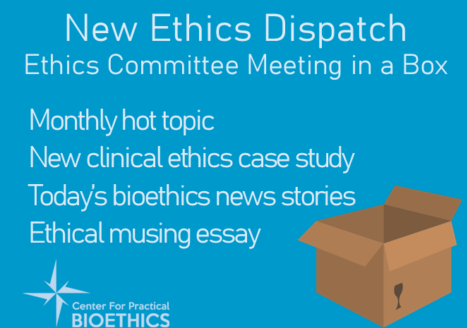
![A graphic stating the Ethics Dispatch is like an ethics committee meeting in a box. With four topic sections: monthly hot topic, new clinical ethics case study, current bioethics news stories and ethical musing essay.]()
Ethics Dispatch November 2025 Beneficence
The November 2025 Ethics Dispatch discusses beneficence in the season of caring . What does it mean to actively do good? 150,000 people with serious mental illness live in nursing homes, often longer than their medical needs require because the broader system has no place for them to go. In the case study we learn about a patient ready for discharge, but no facilities will take him. Then we discuss the shortcomings of EMTALA and how they demonstrate the need to rediscover the theory of medicine so that its practice meets patients’ needs. The Center for Practical Bioethics.