Ethics Dispatch October 2025
“Functioning as our better selves leads to better outcomes for patients and everyone.”
Tarris (Terry) Rosell, PhD, DMin, HEC-C
By Ryan Pferdehirt, D.Bioethics, HEC-C, Vice President of Ethics Services, Rosemary Flanigan Chair
& Cassie Shaffer Johnson, MA, Program Coordinator
HOT TOPIC
Justice in the Age of Misinformation:
Why Bioethics Must Defend the Independence of Science
At a time when information moves faster than ever, truth itself feels fragile. A recent American Journal of Managed Care article about the European Respiratory Society (ERS) Congress 2025 painted a troubling picture: political interference, predatory publishing, and industry-backed misinformation are threatening the independence of science. These pressures don’t just distort academic debate – they undermine the public’s trust in knowledge itself.
For those of us who think deeply about ethics in healthcare and research, this moment demands reflection. Among the four core principles of bioethics – autonomy, beneficence, nonmaleficence, and justice – it’s justice that gives us the clearest moral footing. In research, justice means fairness: fair access to truth, fair recognition for honest work, and fair protection against exploitation and manipulation. It insists that knowledge serves everyone, not just those with power, influence, or funding.
Open-Access Publishing
Open-access publishing has transformed the way research is shared, expanding access to valuable information. But it’s also created a market for predatory journals – outlets that charge for publication without meaningful peer review. As Joel Kaufman, MD, MPH, described in the article, these journals exploit vulnerable researchers who are under pressure to publish quickly, especially early-career scientists trying to build a name. This is more than a professional inconvenience. It’s an ethical harm. When profit-driven publishing platforms bypass integrity, they take advantage of researchers’ trust and damage the credibility of science as a whole. Worse, the public – which relies on accurate information to make decisions about health and policy – is left to sort truth from noise.
And this isn’t the first occurrence of profit-driven intentional disinformation being shilled onto an unsuspecting public as fact. As Philippos Filippidis, PhD, reminded his ERS audience, the tobacco industry “wrote the original playbook” (Jeremias 2025) for twisting science to protect profits. That legacy continues, now amplified by social media and digital marketing. Industries have learned to create doubt, fund misleading studies, and shape public opinion – all while claiming to support “open debate.” This isn’t just dishonest; it’s unjust. It shifts the burden of harm onto the public – onto patients, families, and communities – while those who profit remain insulated. Every deliberate act of misinformation violates the public’s right to truthful, accessible knowledge.
Political Interference
Kaufman also warned that political interference is eroding scientific independence. In recent years, we’ve seen approved research grants in areas like climate change, gender, and diversity rescinded for political reasons – projects reviewed and accepted by experts, only to be canceled by those in power. The injustice here is profound. When ideology overrides evidence, communities lose the chance to benefit from the research most relevant to their lives. The integrity of peer review is not just a technical safeguard – it’s a moral one.
Ultimately, the ERS experts closed their session with a call for collaboration, training, and stronger codes of conduct. But beneath those practical steps lies something deeper: a call for justice. Protecting the integrity of science isn’t only about better systems; it’s about fairness, courage, and care for the common good. If we truly believe in the four core principles of bioethics and implementing them into real-life situations, we must remain vigilant ensuring that all people receive accurate – and just – information.
Stand Up for Evidence
At the Center, we talk often about how ethics lives in the real world, in the everyday tensions between principle and politics. Defending science from partisan manipulation is part of that work. Through our dispatches, our programs, and conversations like this one, we aim to foster the kind of civic and professional courage it takes to stand up for evidence, even when it’s inconvenient.
For us at the Center for Practical Bioethics, that’s what this Dispatch – and our broader mission – are all about. We want to make ethical reflection part of the everyday life of healthcare, research, and policy. Sharing stories like this one is a way of practicing justice: by naming where systems fail, and by reminding one another that truth and fairness are shared responsibilities.
Science and healthcare can only serve humanity if it is honest. And honesty requires justice – fair process, fair access, and fair protection for all who seek to learn and heal. If the integrity of science is under siege, then every conversation like this becomes a small act of defense. By writing, reading, and engaging, we take up our part in safeguarding truth itself.
Sources
Science Under Attack: Experts Warn of Rising Threats to Research Integrity | AJMC
BIOETHICS IN THE NEWS

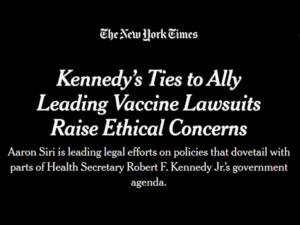
Kennedy’s Ties to Ally Leading Vaccine Lawsuits Raise Ethical Concerns
The New York Times – not open source

CASE STUDY: COPD Patient Rejects Science on Smoking
Bonnie Says, “I’m Going to Believe What I Believe.”
Bonnie is a 54-year-old woman with a history of congestive heart failure and COPD. She describes herself as a “pack-every-other-day” smoker and has smoked cigarettes for most of her adult life. She was diagnosed with COPD several years ago, which has led to multiple hospitalizations and ongoing complications.
She reports having several other conditions, including depression and anxiety, and states that smoking cigarettes is “the least of [her] concerns.” During her most recent hospitalization for shortness of breath, the medical team explained that if she does not make an effort to stop smoking, her quality of life and life expectancy will continue to decline. The team further noted that if she continues to smoke, there is little they can do to improve her condition.
When Bonnie heard this, she became angry and expressed her frustration. She stated that she does not believe smoking causes health problems, noting that her father was a lifelong smoker who smoked until the day he died at the age of 94, without any apparent smoking-related illnesses.
Bonnie maintains that healthcare professionals “don’t really know the truth” about smoking and are “always wrong or changing their minds.” She added, “Tomorrow they might say that smoking is actually good for you, so I’m going to believe what I believe.”
The medical team is uncertain how to proceed with treatment, and an ethics consult has been requested.
ETHICAL MUSINGS
Honesty and Humility:
Recapturing Trust in the Scientific Method
The scientific method is one of the most successful processes for problem-solving that humankind has ever developed. It led us out of the Dark Ages, when natural phenomena were explained only through chaos, dogma, or the sheer whim of the gods. The process of “doing science” has evolved from intellectual exploration, to natural philosophy, to the modern concept of the “scientist” — the figure children dream of becoming when they grow up.
But science itself is not how we fulfill the Enlightenment project. As its name implies, science is a method — a process of problem-solving, not the solution itself. It is a human endeavor, and it will only ever be as good as the people conducting it.
In their article on the virtues of science, Lacchia and Webster identify six virtues: honesty, humility, philia, innocence, generosity, and reticence (La Commedia Scientifica – Dante and the scientific virtues). While all six are important, the recent attacks and criticisms of the scientific community are centered primarily on honesty and humility.
Scientists React to the System
The hallmark of valuable scientific work is honesty. The entire scientific method is designed to eliminate as much personal bias, opinion, and subjectivity as possible. You create a hypothesis, you test it, and you see what the results show. More often than not, your hypothesis is wrong. Then you go back, make changes, and test again. It’s a slow, tedious, and grinding process — but only by following it can we trust that the science is honest.
Unfortunately, the current nature of the educational–industrial complex disincentivizes scientists from acting according to these virtues. As the saying goes: “Publish or perish.” Academics are encouraged to produce the newest and most groundbreaking work. A major scientific breakthrough published in a major journal can make a career — earning promotions, tenure, and prestige. But academia often rewards results, not the grind that leads to them. It becomes more important to publish than to ensure the results are honest.
This isn’t the norm, but a few bad actors can spoil the bunch. A handful of dishonest scientists can erode the trust the community has worked so hard to build. That erosion is what we’re witnessing now. Science and academia are losing public trust because some have cut corners and published dishonest findings. But I don’t necessarily blame the scientists themselves. Their actions are, in many cases, a reaction to the system — a system that rewards breakthroughs over integrity and ties careers and livelihoods to constant achievement.
Science as a Humble Pursuit
This is where humility becomes essential. Humility is the counterbalance to ambition. Science, at its core, is a humble pursuit. It begins with the acknowledgment that we don’t know something — and the willingness to go through the process to learn it. If we already knew the answers, there would be no need for science.
Science now faces a crisis of public trust, a problem shared by many institutions. If the world cannot trust that the work is done with integrity and honesty, the results — no matter how impressive — won’t be accepted or valued. To repair that trust, we must return to the foundational virtues of science, especially humility and honesty. This is not just an ethical imperative but a practical one, essential for the health, safety, and advancement of humankind.
Science once brought us out of the Dark Ages and into the Enlightenment. But without trust and integrity, people will retreat once again to dogma, distrust, and the entitlement of opinion over truth.
Source:
GC – La Commedia Scientifica – Dante and the scientific virtues
Written By Ryan Pferdehirt, D.Bioethics, HEC-C, Vice President of Ethics Services, Rosemary Flanigan Chair & Cassie Shaffer Johnson, MA, Program Coordinator