Tag / Ethics Dispatch
-

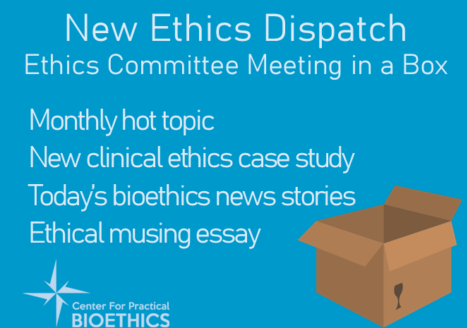
![A graphic stating the Ethics Dispatch is like an ethics committee meeting in a box. With four topic sections: monthly hot topic, new clinical ethics case study, current bioethics news stories and ethical musing essay.]()
Ethics Dispatch December 2025 ECMO
The November 2025 Ethics Dispatch discusses beneficence in the season of caring . What does it mean to actively do good? 150,000 people with serious mental illness live in nursing homes, often longer than their medical needs require because the broader system has no place for them to go. In the case study we learn about a patient ready for discharge, but no facilities will take him. Then we discuss the shortcomings of EMTALA and how they demonstrate the need to rediscover the theory of medicine so that its practice meets patients’ needs. The Center for Practical Bioethics.
-
![A graphic stating the Ethics Dispatch is like an ethics committee meeting in a box. With four topic sections: monthly hot topic, new clinical ethics case study, current bioethics news stories and ethical musing essay.]()
Ethics Dispatch November 2025 Beneficence
The November 2025 Ethics Dispatch discusses beneficence in the season of caring . What does it mean to actively do good? 150,000 people with serious mental illness live in nursing homes, often longer than their medical needs require because the broader system has no place for them to go. In the case study we learn about a patient ready for discharge, but no facilities will take him. Then we discuss the shortcomings of EMTALA and how they demonstrate the need to rediscover the theory of medicine so that its practice meets patients’ needs. The Center for Practical Bioethics.
-
![]()
October 23 2025 Bioethics Bulletin E-Newsletter
Read about justice in an age of misinformation in the Center for Practical Bioethics’ October 23, 2025 Bioethics Bulletin. Other topics include announcing the new Francis co-chairs, our upcoming free lecture, “Jazz, Bioethics, and the Moral Practice of Medicine,” our 2025 Vision to Action award winner, and watch a new case study on the meaning of expertise.
-
![A graphic stating the Ethics Dispatch is like an ethics committee meeting in a box. With four topic sections: monthly hot topic, new clinical ethics case study, current bioethics news stories and ethical musing essay.]()
Ethics Dispatch October 2025
The October 2025 Ethics Dispatch highlights how misinformation, political interference, and profit-driven publishing threaten the integrity of science and public trust in healthcare. Defending evidence and fairness is a moral duty rooted in bioethics’ principle of justice. The Center for Practical Bioethics calls for renewed commitment to truth, transparency, and ethical integrity in research and public discourse.
-
![]()
September 25 2025 Bioethics Bulletin E-Newsletter
Read about The Center for Practical Bioethics’ appearance on KC Cares podcast, how immigrants are being scapegoated by stripping away healthcare access to dismantle justice, watch a new case study on undocumented patients, and how hospitals can save money with ethics services.
-
![A graphic stating the Ethics Dispatch is like an ethics committee meeting in a box. With four topic sections: monthly hot topic, new clinical ethics case study, current bioethics news stories and ethical musing essay.]()
Ethics Dispatch September 2025
In this Ethics Dispatch, the Center for Practical Bioethics discusses the decision to scapegoat immigrants and strip away healthcare access is a cautionary tale about how easily ethics can be subverted by politics. It shows us how fear can be weaponized to dismantle justice, and how health policy can be turned into a tool of harm.
-
![]()
August 28 2025 Bioethics Bulletin E-Newsletter
Read about The Center for Practical Bioethics’ upcoming events, meet Dr. Butin, our 2025 Ethics Champion of the Year, read the Ethics Dispatch focused on ethics of healthcare workers facing patient violence, watch our medical ethics case study on doctor-patient relationships and read about the unique view of our summer Ethical AI intern.
-
![A list of the sections in the Ethics Dispatch.]()
Ethics Dispatch August 2025
Nurses and frontline staff bear the brunt of a growing wave of hostility, facing risks that extend far beyond the usual emotional toll of caregiving. In this Ethics Dispatch, the Center for Practical Bioethics analyzes competing values that govern providers’ response to violence, as well as institutional responsibilities and Ryan shares a personal story about his response to an aggressive family member.
-
![]()
July 24 2025 Email Newsletter
The Center for Practical Bioethics’ July e-newsletter starts with a letter of gratitude to our supporters. This month’s stories include the impact of clinical ethics consultation at a large health system, ethical perspectives on Medicaid cuts, and a bioethics video case study on distributive justice.
-
![Our Ethics Dispatch social media graphic showing glasses a reading tablet and a print newspaper.]()
Ethics Dispatch July 2025
The July Ethics Dispatch is on Why Rural Healthcare Fails Without Medicaid: An Ethical Analysis. With Medicaid cuts looming, we discuss the principles of bioethics to the cuts’ impact on rural healthcare. And we explore the philosophical concept of “ought implies can,” which holds that for someone to have a moral obligation, that person must have the ability to accomplish said obligation. Which begs the question: When do we have a moral obligation to provide Medicaid coverage?
.