Ethics Champion 2026: Dr. Namir Khandker’s Proactive Approach to Clinical Ethics
Published on: August 17, 2026
By Trudi Galblum, MPS
Marketing, Communications, & Grantwriting
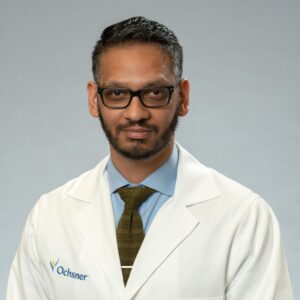 Namir K. Khandker, MD is the 2026 Ethics Champion for the Center for Practical Bioethics. Dr. Khandker will be recognized and awarded for his proactive approach to clinical ethics at the 2026 Breakfast of Champions, the Center’s annual fundraising event, on September 17, 2026.
When Covid hit in 2020, Dr. Khandker was an attending physician at Ochsner Health System’s flagship medical center in New Orleans, two years out from completing his fellowship training in neurocritical care at the University of Pittsburgh Medical Center.
“It was a crazy situation,” recalls Dr. Khandker. “People were dying left and right. Every elective surgery was cancelled. I had the chair of ENT surgery rounding on patients and reporting to me.”
It was also about that time Ochsner was making a concerted effort to rebuild the ethics infrastructure of its 47 hospitals across Louisiana, Mississippi, and the Gulf South region. The ethics committee at the hospital where Namir worked had recently folded after its longtime chair retired. The goal for the new infrastructure was to have an ethics committee for the health system, as well as local committees for each hospital.

To support that effort, Ochsner contracted with the Center for Practical Bioethics for its Vice President of Ethics Services Ryan Pferdehirt, D.Bioethics, HEC-C, to provide clinical ethics consultation services.
Building Multilevel Trust
Dr. Khandker had been exposed to well-developed ethics services in Pittsburgh as well as at Case Western Reserve School of Medicine during his residency. Still, when the system’s chair of palliative care at the time, Dr. Susan Nelson, asked him to lead the hospital’s new ethics committee, he felt unprepared.
And he needed to hit the ground running.
“In the first year, we had like 25 consults,” he said, “but I was okay because I had lots of support from Dr. Pferdehirt. He was someone I could call – in the beginning – on every case. He would guide me through each case as if I were his apprentice.”
Five years since then, Dr. Khandker modestly admits, “I’ve improved.”
Dr. Khandker deflects credit for the strength of Ochsner’s ethics service today to colleagues who trust him and feel confident in bringing cases to his attention.
“What makes Namir stand out,” said Dr. Pferdehirt, “is his proactive approach to ethics.
“Say you have a patient who’s receiving potentially non-beneficial care. Many clinicians would wait till the situation has gone way downhill before asking for an ethics consult. Dr. Khandker gets us engaged as a trusted partner in early decision making rather than as an eleventh-hour solution.”
Helping Patients and Clinicians Be Heard and Understood
Ochsner Medical Center’s ethics committee is comprised about 20 people. Dr. Khandker says that about 30% of the issues brought to it are social problems and 30% are legal that can typically be referred to a different committees and departments. Of the remaining percent that are ethical in nature, the committee determines if there’s an existing policy to address the problem.
“We try to treat similar cases the same way, without bias,” said Dr. Khandker.
If no policy exists, Dr. Khandker brings the full committee together to make a recommendation.
“We try to understand what’s important to the patient and the medical team and find creative space to overcome any conflicting values,” he said.
“What I’ve learned from this work is that people just want to be heard and understood. And, while for the most part that doesn’t always happen in hospitals, it’s reassuring because letting people be heard and understood is something we can act upon. Even if there’s no right answer, we can foster understanding. We can make things better.”
A Framework of Discomfort
Putting himself in uncomfortable situations is nothing new to Dr. Khandker, who was born in Saudi Arabia, spent a few early years in Bangladesh, and moved to Detroit at age four with his family, which includes his identical twin brother – also a neurologist – and an older sister and brother.
Although he laughs at the idea that, as a physician he’s living the “South Asian community dream,” his career in medicine wasn’t a foregone conclusion. Maybe there was even a little bit of rebellion in earning his undergraduate degree in business at Michigan State University.
“Making decisions in a framework of discomfort is something my dad taught me,” he said. “If I have an opportunity to do something new and a little uncomfortable, I say yes. Because that’s where the growth happens.”
After specializing in neurology, Dr. Khandker sought further growth by subspecializing in neurocritical care, where managing critically ill patients with multiorgan failure is a daily responsibility.
That’s not to say he doesn’t find balance outside of work. He’s self-taught on guitar and piano having played in a high school band, and he also enjoys pickleball and photography.

He was recruited to Ochsner, he says, by a friend from residency who worked at the hospital and who he visited while on vacation in New Orleans.
“The climate in New Orleans was like Bangladesh,” he said. “After our first winter here, we could never go back north.”
Author
Trudi Galblum, MPS is a contractor for the Center for Practical Bioethics specializing in marketing, communications and grant writing.